The Hidden Supply Crisis Behind Reforestation
August 23, 2026|ACRE Investment Management
The carbon market keeps borrowing a metaphor that doesn’t fit. The prevailing playbook treats a reforestation carbon offtake like a renewable-energy power purchasing agreement (PPA): sign the contract, build the asset, and delivery risk collapses at commissioning. Clean. Bankable. Familiar. It’s also wrong — and the mispricing matters.
The Tonnes Are Contracted. The Seedlings Are Not.
In a solar or wind PPA, the asset is built once. The day it hits its commercial operation date (COD) and comes online, the hard risk is behind you. A forest is the opposite. Planting isn’t commissioning — it’s the FIRST act of a 20-year biological process. Survival risk, growth risk, drought, fire, reversal — none of it collapses at COD. It persists for two decades. So a contract structured on a PPA risk curve systematically under-provisions for the risk that actually exists.
Nowhere is that clearer than at the front end, where the nature-based market has a supply problem almost nobody is pricing.
The US produces roughly 1.3 billion tree seedlings a year. Credible reforestation ambition needs closer to 3 billion. But the real bottleneck isn’t raw volume — conifer plugs are relatively abundant. It’s diverse native hardwoods, the exact species mix high-integrity carbon projects depend on. Western nursery surveys show seed inventories that can cover under 5 years of conifer needs but barely 2 years of hardwood needs at current levels (USDA Forest Service). You can’t spin up hardwood nursery capacity on a carbon-market timescale: seed has to be collected in mast years, stratified, sown, and grown for a season or two before a single acre goes in the ground.
Now layer that onto a 20-year offtake obligation financed with debt. And here’s the part the PPA framing misses entirely: a missed planting season doesn’t cost you one year — it compounds.
One Missed Season Becomes a 20-Year Problem
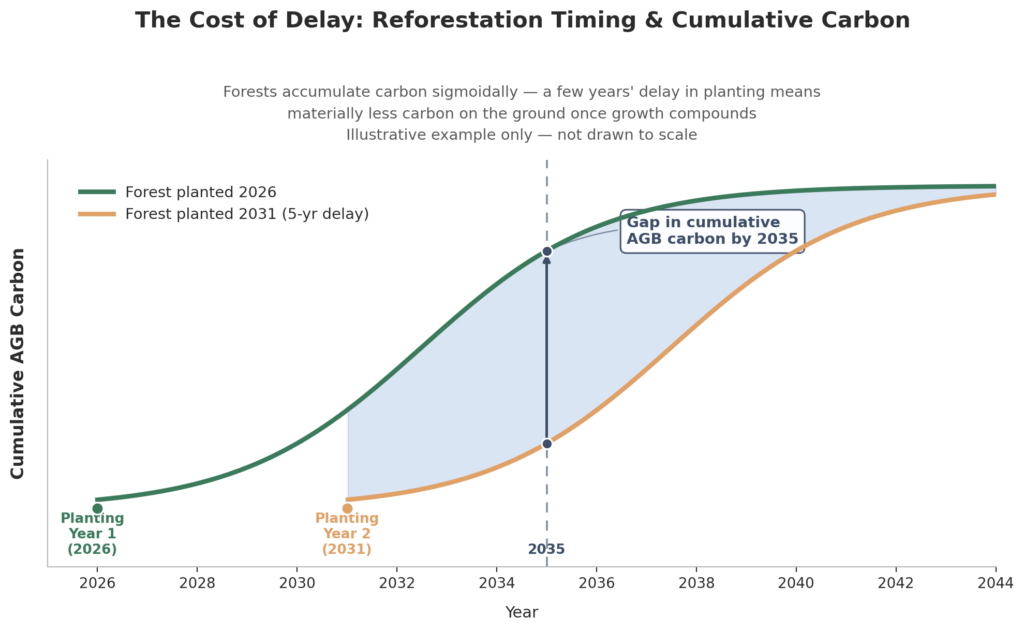
Think about why. Those acres never start their growth curve, so you don’t just lose this year’s planting; you lose every tonne those trees would have sequestered over the next two decades, plus the compounding of biomass on biomass they’d have driven. Miss the window and you fall behind the delivery schedule, so you replant into an even tighter seedling market next season — and every subsequent vintage arrives late. On a debt-financed project, delayed issuance strains coverage ratios exactly when you can least afford it, which can force credits to be bought on the spot market at precisely the moment scarcity has spiked the price. One lost season cascades into lower lifetime tonnage, a slipped schedule, and a financing squeeze — all at once.
One lost season cascades into lower lifetime tonnage, a slipped schedule, and a financing squeeze — all at once.
That’s not a discrete event a PPA-style make-good clause neatly resolves. It’s a slow, cumulative, path-dependent divergence from the growth curve — and it gets worse the longer it goes uncorrected.
The Registry Data Is Already Sending a Warning
This is not only a theoretical risk. Registry data is already showing the gap between projected and delivered supply.
- Many ARR projects fail validation. A total of 54 ARR projects were under validation with Verra in 2023. Today, 33 of those projects have passed validation, while the remaining 21 projects were rejected or have stalled. This equates to a validation rate of 61.11% (Verra Registry).
- Most ARR projects significantly underperform their ex-ante issuance projections. Verra lists 69 ARR projects that have issued credits—a cumulative total of 30,223,623 tCO2e as of July 2026. However, according to these projects’ registry documentation (which is on average 10 years old), the projects projected a total cumulative issuance of 83,559,530 tCO2e by 2026. In other words, only 36.17% of Verra’s projected ARR credits have been issued between 2023 and 2026, indicating projects underperformed by 63.83%.
- Projected CCP-labeled ARR supply through 2050 is significant. There are a total of 92 projects under validation, undergoing registration, or registered with a CCP-eligible ARR methodology. Together, these 92 projects are estimated to total 543,407,033 tCO2e in cumulative issuance between now and 2050. But that headline number assumes every project clears validation and hits its ex-ante projections — neither of which the historical data supports. Applying the observed validation rate of 61.11% and a performance rate of only 36.17%, the projection declines to 196,551,241 tCO2e for the 2026-2050 period, meaning fewer than a quarter, about 22%, of the pipeline’s advertised supply is likely to actually materialize.
A Contract Is Only as Strong as the Counterparty
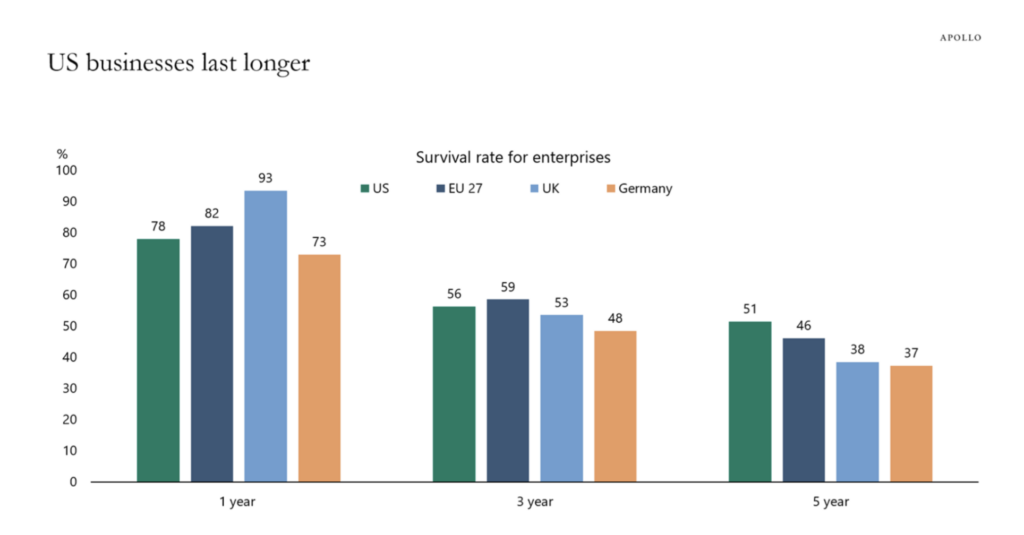
The problem amplifies because some forward contracts for new projects have included liquidated damages provisions–but those protections are only meaningful if the developer remains financially viable. As the chart below shows, just 37% to 51% of U.S. businesses survive beyond five years, while reforestation offtakes can extend 20 years or more (Apollo Global Management). Coupled with nursery scarcity and the underperformance of ex ante projections, this counterparty risk could leave carbon removal credits in short supply as early as 2027.
Two Realities Every Carbon Buyer Must Account For
- Stop importing PPA risk assumptions into biological assets. The delivery risk is bigger, it’s persistent, and it compounds — price it and provision for it accordingly.
- Treat hardwood seedling capacity as the strategic constraint it is. In a supply-short market where a single missed season cascades for years, proven origination and real nursery capacity aren’t commodities. They’re the scarce asset.
The problem amplifies because liquidated damages provisions only protect buyers if the developer stays financially viable.
A Possible Solution
The Market Needs Delivery Insurance
The solution is a delivery insurance product designed for biological assets. Consider a project contracted to deliver 100,000 tonnes at $20 per tonne but delivers only 36,000 – in line with the 36.17% average performance rate seen across the Verra ARR portfolio. At $20 per tonne, that shortfall project earns $720,000 on the tonnes it did deliver. But if replacement credits of the same vintage, utility, and kind now cost $50 per tonne, the project faces a $3.2 million replacement obligation for the 64,000-tonne gap — a net loss of $2.48 million. For young firms still building capital, one shortfall could threaten the entire enterprise. The market needs insurance that can settle these delivery gaps, protect buyers and prevent biological underperformance from becoming project failure.
For the past 23 years, ACRE has done more than just create a successful company. ACRE has created an entirely new market. This was intentional. Reforestation and restoring natural systems are the only way to play climate offense. Growth in the ARR industry is not a “nice-to-have” for our organization. It is the point.
A few years ago, we began digitizing our experience through the ACRE IO platform. Today, we are partnering with AIO to bring a delivery insurance product to the marketplace. We will leverage AIO’s underwriting engine and remote sensing capabilities, coupling them with ACRE’s carbon removal supply and its scalable nursery infrastructure.
This communication is provided for informational purposes only and is not a substitute for your own research or professional advice. This communication does not constitute investment, legal, tax, accounting or other advice, and should not be relied upon as such. Certain statements herein may be forward-looking in nature; actual results may differ materially due to risks and uncertainties and ACRE Investment Management, LLC and its affiliates undertake no obligation to update such statements. ACRE has not verified or substantiated any third-party representations or content contained in this communication. Hyperlinks to third-party websites are provided for convenience only, and ACRE does not endorse or take responsibility for their content. ACRE cannot accept responsibility for any loss or damage arising from the use of this communication.

About the author
ACRE Investment Management