The Wealth Beneath Our Debt: Rethinking America’s Natural Capital
September 29, 2026|ACRE Investment Management
One common measure of a country’s fiscal health is its debt-to-GDP ratio — that is, how much a country owes relative to the total value of its economic output. Among major developed nations, most carry debt-to-GDP ratios above 100%, with the United States currently at about 125%. But GDP itself is a limited and arguably misleading measure of well-being. As the late economist Herman Daly observed, GDP measures economic hyperactivity. Every time money changes hands, GDP rises, regardless of whether the underlying cause was productive activity, pollution, a car accident, or a medical crisis. Against this backdrop, the rising U.S. debt load and the escalating interest payments, creating a troubling dynamic: both the numerator and denominator of the debt-to-GDP ratio are spinning faster and faster, making it increasingly difficult to grasp the full consequences of where this trajectory leads.
Is recalibration a possible solution? Could carbon help us drive down U.S. debt and create real longterm financial and environmental sustainability?
A better way of calibrating where we are would be to measure our debt-to-land value. Land offers a far more stable and tangible benchmark than
the frenetic churn of economic consumption
that GDP captures.
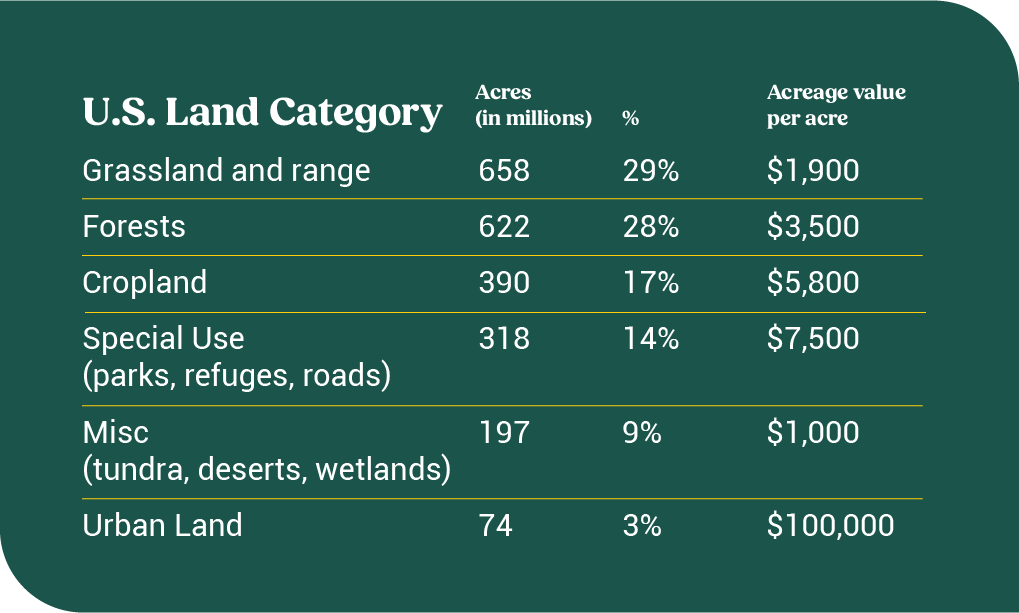
If we look at the blended weighted-average value of land in the US, it’s roughly $6,900 per acre. Therefore, the debt-to-land value is more like 246%. However, excluding urban land drops this to a weighted average of $3,785 per acre. This equates to a debt-to-land value of 465%.
The Cost of Interest—Measured in Acres
The current interest on our debt—approximately $1 trillion — is already more than 12% of the value of non-urban land. Let me repeat this. At current interest rates, the U.S. is effectively consuming the equivalent value of roughly 264 million acres of land per year—about 12% of the country’s total 2.26 billion-acre land base.
At the same time, we continue to treat the earth as though it were a business in liquidation — destroying the air, land, water, and the biodiversity these resources support. The primary driver of this destruction is the expansion of urban land, which accounts for nearly 70% of U.S. emissions. Yes, 3% of the landmass is responsible for 70% of total U.S. emissions. Total U.S. CO2 emissions are 6.3 billion tons per year before adjusting for land sequestration.
Putting a Value on the Carbon Our Land Can Capture
Is recalibration a possible solution? Could carbon help us drive down U.S. debt and create real long-term financial and environmental sustainability?
Take the 2.2B acres of non-urban land. Let’s say the average acre sequesters 4 tons of CO2e per year for a total of 8.8 billion tons across the U.S. At a price point of $100 per ton, the value of that annual sequestration is $880 billion. And at a $200 price point, that value is $1.76 trillion. Keep both numbers handy.
At current interest rates, the U.S. is effectively consuming the equivalent value of roughly 264 million acres of land per year — approximately 12% of the country’s total 2.26 billion acre land base.
What if the federal government created a tradable and transferable tax credit for land-based carbon sequestration priced at $250 per ton? Think of this as investing in the next 250 years. Let’s say those tax credits traded at 80% value, or $200 per ton, and that the federal government split the proceeds with landowners. This arrangement would generate $880 billion per year for landowners and $880 billion per year for the federal government to pay down the principal on the $40 trillion national debt. In 44 years, such a program would eliminate the current U.S. debt. In doing so, we would recalibrate our relationship with nature and monetary policy by putting nature on the balance sheet. And this is just the beginning; as we begin to value other natural capital assets like water and biodiversity, we will fundamentally change and reinvent our economic order by putting humanity back into markets.

About the author
ACRE Investment Management