Ten Principles of Blended Finance for Reforestation and Their Economic Implications
October 2, 2026|Chandler Van Voorhis
By B. Chandler Van Voorhis, Co-Founder and Manager at ACRE Investment Management
Adapted from the Reforestation Blueprint session at the Natural Capital Investment Forum 2026, September 24th, 2026
How growth, space, time, risk, and finance shape the economics of the reforestation market
In the fight against climate change, what does winning look like?
Does it mean scale? Speed to scale? Looking beyond carbon to the full value of air, land, and water? Or does it mean bringing nature and restoration into our economic orbit while allowing the principles of nature to change how we think?
These questions shaped ACRE’s Natural Capital Investment Forum at NYC Climate Week 2026. They also frame a challenge we have spent more than two decades working to solve: making reforestation work for landowners, investors, and buyers.
The answer begins with the asset itself. A forest develops over decades. Its growth, risks, and returns unfold on different schedules. Technology can improve measurement and reduce delays, but trees still need time.
It takes 20 years to grow a 20-year-old forest. There are no shortcuts.
That reality must shape the financing. Blended finance brings public support and private capital together to bridge the economic viability gap for reforestation projects. It must support the full life cycle, including the years when costs arrive well ahead of revenue.
Ten principles explain why.
1. Reforestation begins with a land use decision

The transition from one land use to another requires, by definition, transitional capital.
Reforestation begins with a landowner deciding what the land should become. Converting an agricultural field to forest changes its management, income schedule, and future uses.
That decision sits within an established agricultural ecosystem. Crop markets, leases, insurance, financing, and public support create an economic inertia around the existing use. Even on marginal land, farming has a familiarity that a new forest does not.
A credible alternative must answer practical questions. Who pays for planting? What replaces the income given up? What is the gap and how is that gap made up? Who manages the forest, and what happens when trees need to be replanted?
The answers differ from parcel to parcel and landowner to landowner. Some acres should remain in agriculture. Others may offer a stronger long-term opportunity through restoration.
The economic comparison therefore extends well beyond the price of carbon. It includes the costs, timing, risks, and flexibility of two different uses of land and the timing of that revenue
2. Agriculture and forests grow on different clocks
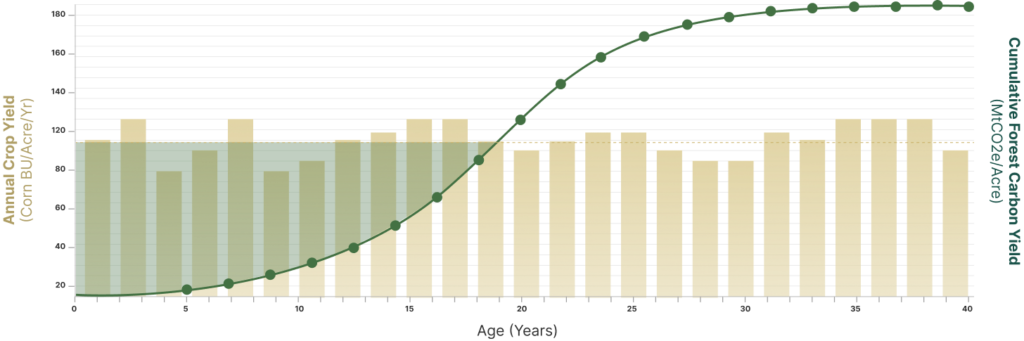
The sigmoid, or S-shaped, curve describes growth that begins slowly, accelerates, and eventually moderates. The difference between agriculture and reforestation is the time over which that curve unfolds.
With annual crops, a farmer plants, grows, and harvests within a season. Weather, costs, and commodity prices affect the result, but the opportunity to earn income returns each year.
With reforestation, growth unfolds over decades. Carbon storage builds as the forest develops, while annual growth varies with species, age, and site conditions. Stored carbon, annual removals, and saleable credits are related, but they are different measures.
Another aspect of the second clock is the time between measuring growth and receiving payment. Monitoring, verification, issuance, and sale can add substantial delays. An illustrative 18-to-24-month payment interval would create a working-capital gap even after growth occurs.
The landowner is waiting for both biology and the market.
USDA’s October 2023 report to Congress cited a survey showing 93% awareness of carbon markets among livestock and cropland managers, but only 3% participation. It identified costs, uncertain returns, and market complexity among the barriers. Awareness alone will not bridge the gap. The economics must work when the landowner needs them to work.
3. Space and growth place limits on the financial model
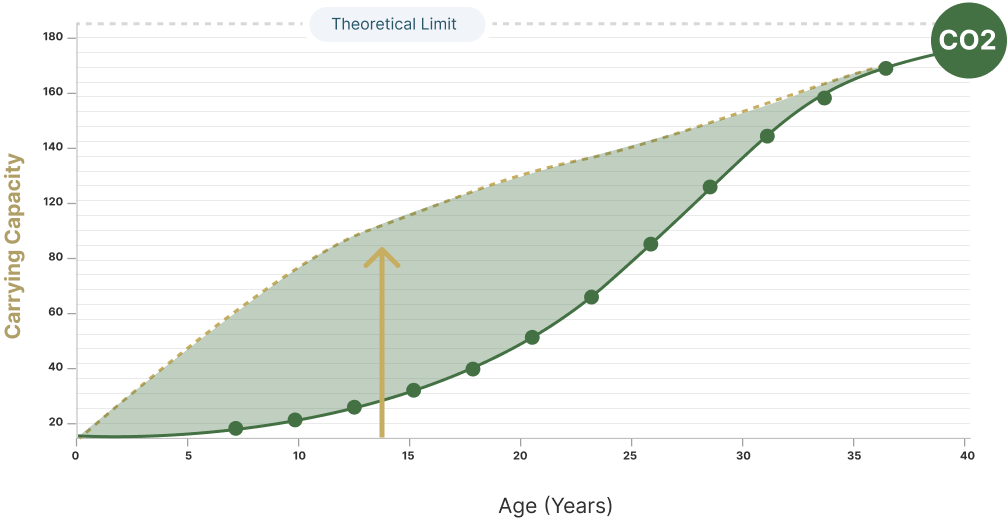
Every acre has limits. Light, water, nutrients, soil, and competition influence how much biomass it can support and how quickly that biomass develops.
The economic question is how to work within those limits. Faster growth and earlier canopy closure may improve the timing of carbon revenue. But a forest must also be managed for diversity, survival, habitat, and resilience.
A model focused solely on early carbon accumulation can undervalue what sustains the asset over decades.
At GreenTrees, planting approaches include fast-growing native cottonwoods alongside native hardwoods, as well as hardwood-only plantings. The design must fit the site and the forest being restored.
The financial model must fit as well. Planting costs, growth, mortality, carbon prices, and management decisions all affect the return. Canopy closure is one milestone in that process. It does not end the work.
4. Planting is the first step in constructing a forest, not the final one.
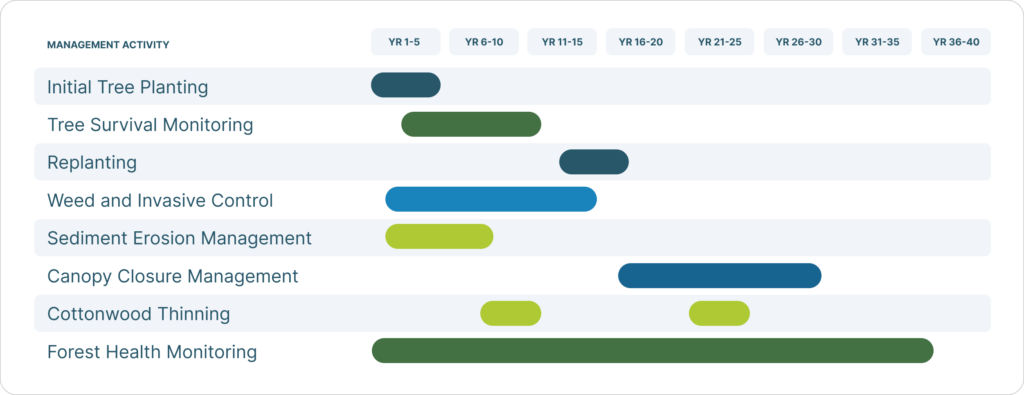
Planting is the first step in constructing a forest. Much of the work that determines its success happens afterward.
For bottomland hardwoods, we describe development through a Roots Phase and a Shoots Phase. The Roots Phase emphasizes below-ground establishment and adaptation to the site. The Shoots Phase describes the more visible growth as trees become established.
The phases overlap. Trees grow above and below ground throughout their lives; dividing development into two decades is a planning shorthand, not a universal biological schedule. The important point is that growth is not always visible.
Management also continues well beyond planting. In our GreenTrees experience, we replant on average around year 14. That is a program observation, not a prescription. It tells us that continued assessment and intervention belong in the budget.
Soil is the forest’s operating system. Roots, fungi, organic matter, and water movement help determine how the ecosystem functions.
Looking deeper can improve our understanding. Research highlights significant carbon below commonly sampled surface layers, alongside uncertainty about its distribution and change. Where conditions and methods justify it, examining the first 100 centimeters can reveal what shallower sampling misses.
One of the first stages of establishing a forest is turning dirt into soil. As trees lay down their roots and microbial activity increases, the table is being set for the shoot face.
The financing must support the forest we are building, including the parts we cannot readily see.
5. The forest must grow before verified removals can be delivered
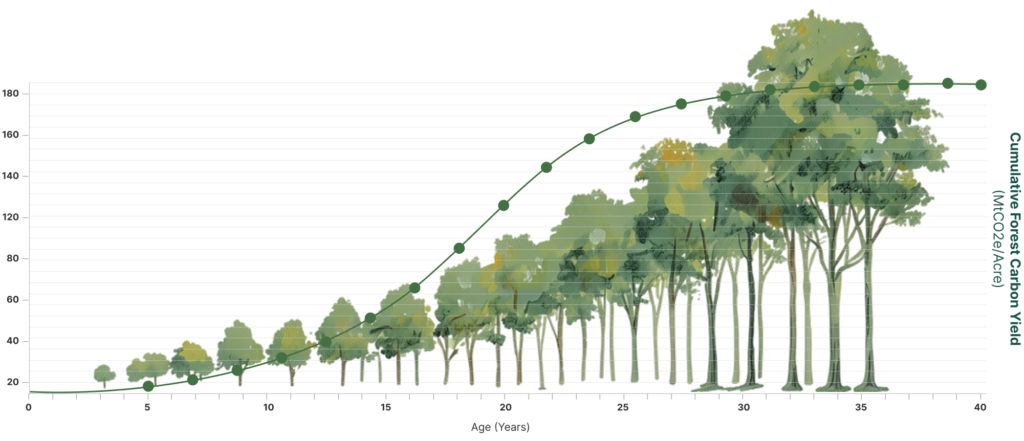
Unlike IFM or REDD+ where a forest exists already, with ARR one has to first grow a forest before one can produce carbon. This requires heavy CAPx expenditures. Site preparation, seedlings, planting, maintenance, and monitoring must be funded while the asset develops.
With improved forest management and avoided deforestation, the forest is already there, and thus, there are little to no capital expenditures. What is required is a management change and operating expenditures. Those projects have their own costs and obligations, but their starting point differs from creating a forest on previously cleared land.
That difference matters when borrowing financing models from other sectors, as the yield curve and capital outlays are essentially inverses of each other.
A power purchase agreement can help finance a renewable-energy facility. Applying the same logic to reforestation requires recognizing that planting marks the beginning of a long biological development process. Delivery commitments must account for growth, verification, and the capacity to absorb delays.
Forward purchases can provide demand certainty and advance funding. Problems arise when their obligations run ahead of forest creation
Consider a hypothetical contract to deliver credits at $20 per ton. If a shortfall requires replacement credits that now cost $50, the price gap is $30 per undelivered ton. On a 100,000-ton shortfall, that gap alone is $3 million, before project costs and other contract terms.
Cash insurance may help pay for a remedy. It cannot guarantee that credits meeting the required characteristics of same utility, kind, and vintage are available.
The lesson is to align delivery schedules, reserves, and remedies with the asset’s development. Equally important, the management team’s capitalization must match the long-term nature of the asset itself. Patient capital and well-designed purchase agreements can work together. However, a young forest needs a financial structure that leaves room for biological variability.
6. Aggregation makes small parcels economically accessible
Reforestation happens in small chunks of acreage. One landowner restores a field; another plants land that floods too frequently to farm reliably. Together, those decisions can restore a landscape.
Our average participating tract is less than 200 acres, with properties ranging from approximately 4 to 3,500 acres. For many, entering the carbon market independently would be economically impractical. As the USDA reports, these barriers to entry are significant.
Accounting, verification, legal work, and sales require specialized expertise and carry costs that small volumes of credits struggle to support. Aggregation spreads those costs across a larger base and gives landowners access to shared infrastructure.
That infrastructure also takes time to build. GreenTrees spent roughly its first decade and a half operating at a loss while establishing the relationships, acreage, and operating capacity needed to serve these markets.
The patience was part of the model. A growing base of acres and developing forests could support economics that individual parcels could not achieve alone.
Aggregation also brings together forests of different ages, helping manage the timing of supply as younger plantings develop. It does not eliminate shared risks, including regional weather events, but it helps to insulate them.
Scale comes from connecting many landowner decisions to a platform capable of supporting them over time.
7. Blended finance must bridge income and time
Nature grows through branching, repeating patterns across scales. Roots, trees, stands, and landscapes help us see the fractal character of living systems.
Finance works through investment sizes, payment schedules, and exit horizons. Bridging these worlds requires a structure that respects how nature occupies both space and time.
Reforestation must cross two gaps at once.
The first bridge is upward, across the income gap. The landowner compares the economics of restoration with agricultural income and the public support underlying the existing system.
The second bridge is horizontal, through time. Establishment and management require funding before the forest generates enough saleable credits to sustain itself. Attractive long-term economics do not automatically solve an early cash shortage.
Blended finance assigns different sources of funding to the stages and risks they can best support. Public conservation funding can help enable an eligible land-use transition. Private capital can support development, operations, and aggregation. Buyer commitments can improve revenue visibility, while verified carbon sales help sustain stewardship.
The timing and terms matter as much as the amount. Funding must fit program eligibility, crediting requirements, and the project budget.
The purpose is to bridge the years and the economics, giving restoration the conditions it needs to endure.
8. Storage on the Stump
Landowners in agriculture and timber are accustomed to participating in various commodity markets. Therefore, they intuitively understand the concept of storage on the stump. When timber prices are unattractive, they may defer harvest, allowing trees to remain standing while growing in volume as they wait.
In the timber world, this is a lesson in preserving flexibility. Debt service or rigid delivery schedules can force decisions at precisely the wrong time.
In the carbon market, the ability to wait has value. In the early years when the S-curve of growth yields small amounts of carbon per acre, the sunk costs of measurement and verification, coupled with the lack of acreage, can make the barrier to entry nearly impossible without aggregation. Each delay allows more volume to accumulate on the stump as each successive vintage gains more value per ton.
Carbon and timber may offer different opportunities as a forest matures, but those opportunities must fit the project’s obligations.
A sound financial structure gives the landowner room to make appropriate decisions within those commitments. Storage on the stump reminds us that part of a forest’s value lies in when we choose to realize it.
9. Building a multi-story asset.
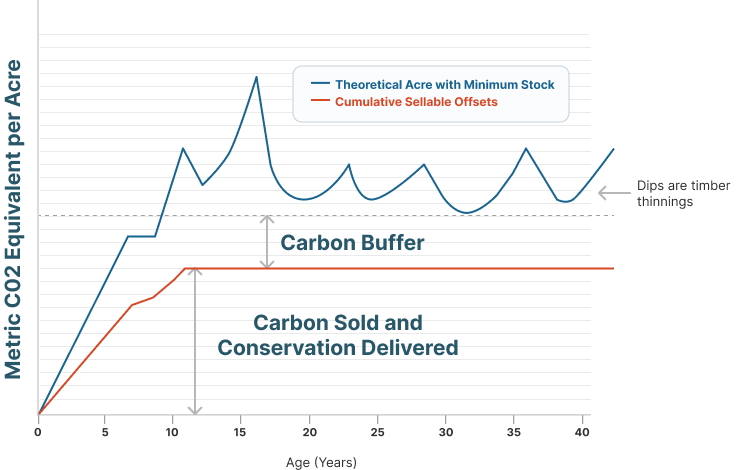
From the beginning, the design of a reforestation project is to build several assets at once. Carbon, biodiversity, and their permanence form the first story. Together, they establish the foundation of a living asset whose value develops over time.
In this structure, any timber rights are junior in the asset waterfall. Their value must be considered within the commitments that support the forest’s continued existence and ecological health. The order matters because it shapes how the forest is established, managed, and ultimately valued.
Species selection and spacing reveal that intention. They influence how trees occupy the landscape, how the canopy develops, and which types of wildlife the forest attracts. A planting decision made today helps determine the habitat, carbon storage, and future management opportunities available decades from now.
Each consideration tells us what type of forest the landowner intends to build and maintain. Active, ongoing management carries that intention forward through decisions about replanting, thinning, and the balance among species as the forest matures.
Carbon helps support the permanence of the forest and its biological values by giving the standing, growing ecosystem an economic purpose. That revenue can help sustain stewardship while other benefits continue to develop.
Building a multiple-story asset therefore begins with understanding how its values fit together. The strength of each story depends on the health of the whole forest and the commitment to maintain it across generations.
10. Law of optimization
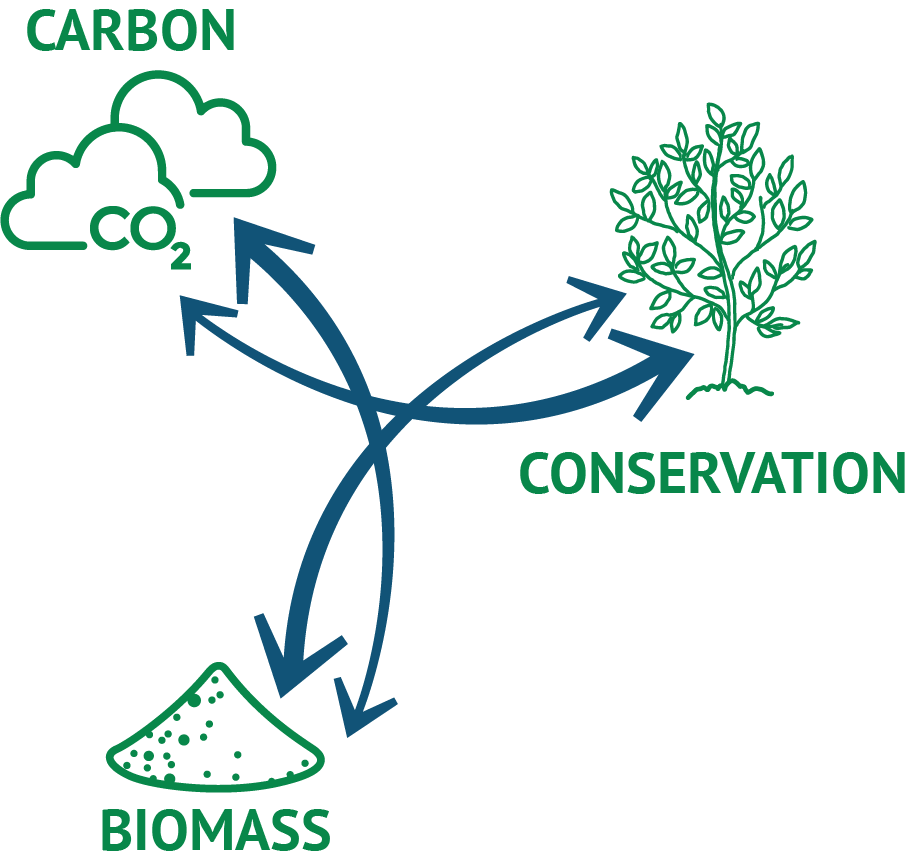
With reforestation, the intent is to optimize multiple outcomes. Just as the market expects each carbon credit to carry co-benefits, the landowner has multiple reasons for planting trees. Carbon is one source of value within a larger vision for the land.
A landowner may want to restore wildlife habitat, improve water quality, create future timber income, or leave the property in better condition for the next generation. These objectives shape how the forest is planted, managed, and allowed to develop. The growth and health of the forest are the foundation on which those values depend.
The Law of Optimization asks us to consider these outcomes together. Maximizing one source of value today can limit another tomorrow. The fastest-growing tree may not serve every objective. The highest immediate payment may come at the expense of flexibility. Decisions about species, thinning, replanting, and harvest must account for how the whole forest develops over time.
That balance changes as the forest matures and the needs of the landowner evolve. A sound financial structure must allow for thoughtful management within the commitments made, giving landowners room to sustain both the ecological health and economic value of their forest.
Reforestation is an investment across generations. We are growing a living asset whose value takes many forms, and whose future depends on how well we manage those relationships today.
A playbook for financing the full life of a forest
What, then, does winning look like?
It includes scale: making participation practical across many properties. It includes speed to scale: improving enrollment, data collection, verification, and access to capital. It includes looking beyond carbon to the habitat, water, and other ecosystem benefits that restoration can provide.
Technology has a clear role. Better information can help us identify suitable land, assess growth, manage uncertainty, and reduce avoidable delays. The greatest gains come when those improvements make the economic system more responsive to the forest’s development.
An Air, Land, and Water approach also widens the way we assess value. Carbon is one measurable outcome within a larger living system. Additional environmental markets may support some projects, where benefits qualify and claims are accounted for properly. Benefits without a ready buyer still matter to the landscape and the people who depend on it.
Bringing nature into the economic orbit means building institutions, contracts, and capital structures that recognize those relationships.
That is the spirit behind a Playbook for the Planet, our newest campaign. Preparation makes restoration possible. Continued stewardship helps restoration endure. Resilience depends on both.
The ten principles lead to a practical conclusion: finance the land-use decision, finance the years of establishment, finance the infrastructure that connects small properties to markets, and finance the ongoing work of maintaining the forest. Recognize the multiple sources of value being created, and preserve the flexibility to manage them over time.
A successful reforestation sector will grow when public and private capital can work together over time, supporting each stage with the tools it requires. Winning means creating the conditions in which landowners can commit, forests can mature, and the value of restoration can endure across generations.

About the author
Chandler Van Voorhis
Chandler Van Voorhis is a leading expert in conservation and ecological markets, with experience including a TEDx Talk, guest lectures at Princeton and Yale, and several publications on natural capital. Before co-founding C2I, he co-hosted the nationally syndicated GreenWave Radio show. He received the ChevronTexaco Conservation Award in 2002 and served as President of the Alliance for Environmental Education. Currently, he serves on advisory boards for IETA Natural Climate Solutions and RenewWest and is a member of the Outdoor Writers Association of America.